Milby High School:Train Bell:The Texas
Local History rings true for Milby High School keepers of “Texas” Locomotive Bell:
The History of a Train Called Texas
So many small, interesting details get lost in the big picture of our state’s history. Today, I am privileged to tell a story about a local train called Texas. Please note the train referred to at the Texas will be italicized to separate it from the state. The brief back story sets the environment in which the train functioned, how it was used, and the significant events it went through. Texas is overshadowed by its predecessor, The General, but we focus on Texas due to its local connection to a High School here in Houston.
This story starts before the train was even built. P. Briscoe may have been a writer and witness to the contract between his brother and others about the railroad’s rich history—the original contract dates to February 28, 1840, and as such states.
“The first railroad built in Texas was the Buffalo Bayou, Brazos, and Colorado, commonly called in its early days Harrisburg railroad.”
Andrew Briscoe oversaw obtaining lands, contracts, signatures, and funds. Due to Texas history at the time of a Mexican invasion being admitted at any moment, property sales were slow, and the project was somewhat abandoned. This is where Sidney Sherman comes into the picture. He helped tie up loose ends and would become known as General Sherman in the Civil War.
“in March 1847, a Harrisburg town company sold and transferred all the unsold town lots and land to Sidney Sherman…”
He is the namesake of the more famous train, which is how the General got its name. It was the first locomotive to have a pull throttle. These two trains would be involved in a historical event brought about by the Civil War, although more on the Great Locomotive Chase of the Civil War later.
I give this back story so readers can understand the much different fate of the second train. The author of this original document, A. Briscoe, details the design and function of the locomotive. He describes it as unlike any other train he’d seen for the time, which had minimal service on the road. Texas appears to have had difficulty going around slight curves and the tracks, though it could pull heavy freight. I was surprised when reading the source, which describes how his predecessor had done wonderfully.
I was sad to hear that Texas was considered worthy of the scrap heap and survived only because it was sold to a sawmill as helpful equipment. I knew my research would uncover more about the train and how it went from in-service to scrapheap. This first document does not tell the whole story.
The next question is, then, who created this beautiful train? It was “Danforth, Cooke & Co. of Paterson, N.J., in 1856.” Other locomotives such as Austin, Columbus, and Harrisburg would show the state's naming history. The railroad was sold in 1868 when it changed its name to the Galveston, Harrisburg, and San Antonio railroads.
Our story of Texas, though, does not end here. This photograph of Texas that I have included is the restored version. The following article from The Salisbury Post talks about the display of the train Texas after it has been refurbished. This article covers the train’s rich history:
“The engine became famous, along with the General, for its role in the Great Locomotive Chase of the Civil War. During Reconstruction, the engine was put to work for the Western & Atlantic Railroad. “The locomotive served for 51 years on the famous Western & Atlantic Railroad, contributing significantly to Atlanta’s rise as a railroad center and, ultimately, an international city,” said Sheffield Hale, president and CEO of the Atlanta History Center.” After viewing the iconic train, we will be returned to Atlanta.
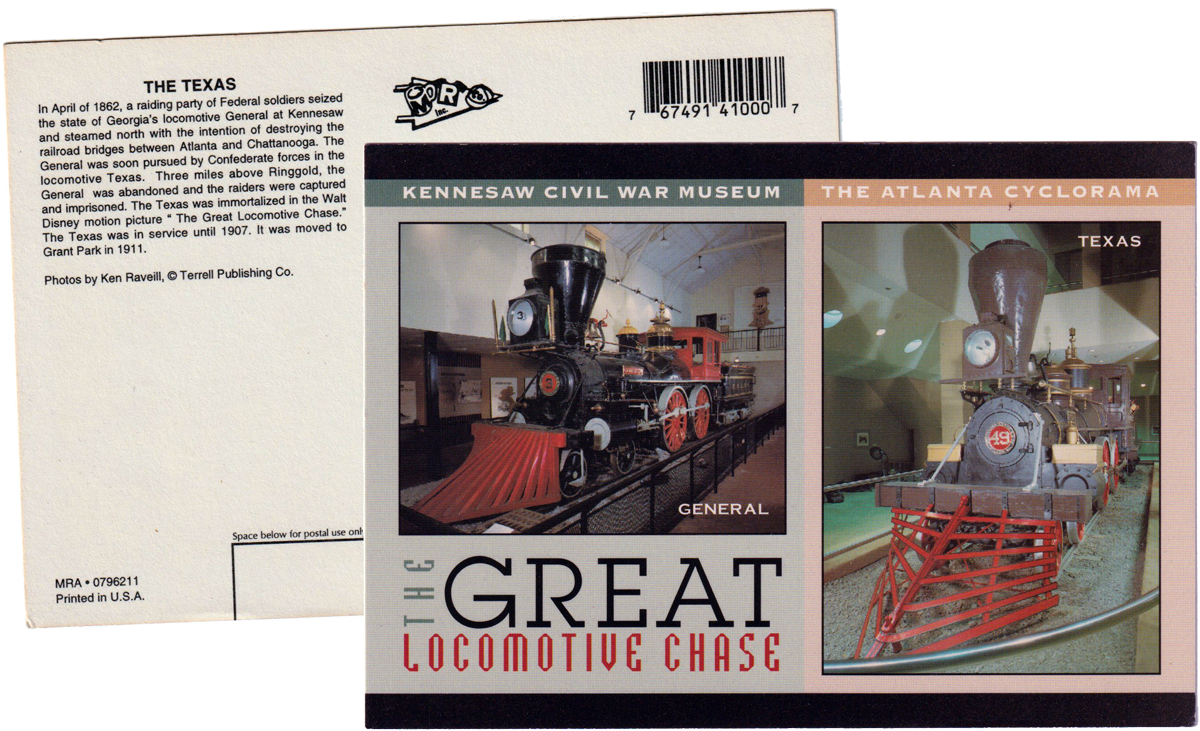
I then discovered that this piece of history has entered through a modern-day filmmaker. None other than Walt Disney himself who worked on such a film. This information is from Hawkins rail.net. (If you want to get ALL the details, go here. This is an excellent photo reference as well.)
“The Great Locomotive Chase, also known as the Andrews' Raid, was a military exercise on April 12, 1862, in northwestern Georgia during the American Civil War. ….The Federals were pursued by Confederate forces first on foot, then later on a succession of handcars and locomotives -- including, by the end, a sister W&A locomotive, Texas.”
I include the following paragraph because it directly mentions Texas. Please note that this was a severe event, even though the above paragraph does say military exercise. Railways were damaged, and people lost their lives. Another name for this train chase is the Andrews raid,which took place on April 12, 1862, in northwestern Georgia. The train I first mentioned, The General, also plays into this.
“Because the Union raiders cut telegraph wires as they went along, the Confederates in pursuit of The General could not send warnings ahead to Southern forces along the railway.”
The Confederates in charge of the time eventually captured the raters, metals were given, and the trains themselves would await modern-day restoration. Like with the detailed information on Hawkins Rail, I found another wonder and excellent source on the restoration. If the 'Texas' Could Talk. by Kevin Keefe, this Classic Trains article is also a good resource.
“Because only a small fraction of the original engine remains, the Atlanta History Center restored the Texas to its appearance in 1886, when it was one of the workaday 4-4-0s that propelled Atlanta to greatness.”
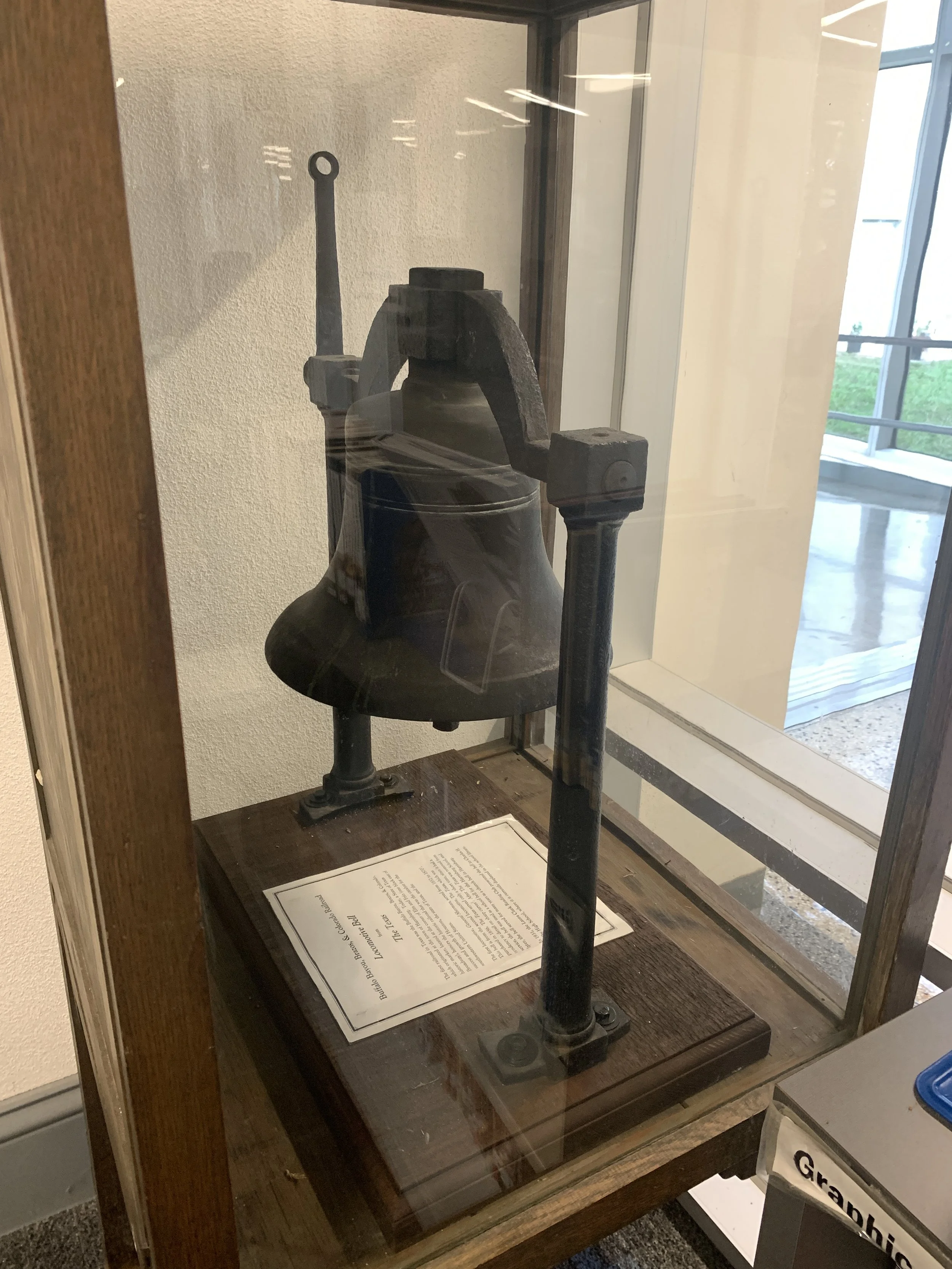
Milby Train Bell: Kelly Johnson 2026
This train has a deeper connection to Houston, than most might realize. My friend, who runs a Facebook group, Harrisburg History Hunters (please check out our page links below,) was the one who told me about this fascinating topic.
Let’s let this story return to more local roots with how the bell of Texas came to Houston High School in the first place. That’s right; you do not have to go out of state to see the piece of this vital train. So, this begs the question then.
How did students at Milby High School come to own an iconic piece of this locomotive?
How helping to volunteer to get others to vote lead me to finish this article on Milby, that has been a few years in the making. So, I made a trip to Milby High School today. It was for the Texas League of Women Voters: I am a new volunteer there. I parked on the street and followed another visitor into the school. After I signed in, a student named Samanthia took me up to the classroom of Mr. Rodreguez. He was the contact for the league. I found out as we stepped out of class the voting registration had been canceled.
So I switched gears and asked him about the bell in the library. I need to see it. I learned about the bell through my friendship with Wayne who runs the wonderful history page on Facebook called The Harrisburg History Hunters. You should go check it out; it got me to write this article.
Mr. Rodreguez arranged for another student to take me to the library. Once inside the library I walked right past the bell and did not notice. I got to talk to a Mr. Juan Rayes. There I got an update and found out he is acting as the school temporary librarian. The former librarian no longer works there; she had been kind enough to get me in touch with Mr. Williams. I had the pleasure of corresponding over email with Dr. Don Williams who is the JROTC teacher here at Milby, (at the time I wrote to him). He does tours in the city and was the one to flip over the paper in the case, so I could see it. I learned so much from him in the research of the bell.
However, in the library Mr. Rayes let me take photos of the bell and said I could visit anytime. I took pictures of the bell and its sole document in the case. The glare was pretty bad, but I did my best.
I know two coworkers who went to Milby High School. One of them was kind enough to answer a few questions I had. My main question was how popular or well known is the bell? Did incoming students know about it. From what I gathered that most did not know about the bell.
Here is what Julissa told me. “I’m sure some know about it but it might also just be an artifact in the library! And I genuinely didn’t! I did my research after we talked about it.” I sent her a photo of the bell. So now that we have an idea of what students think of the bell lets see what the documents has to say.
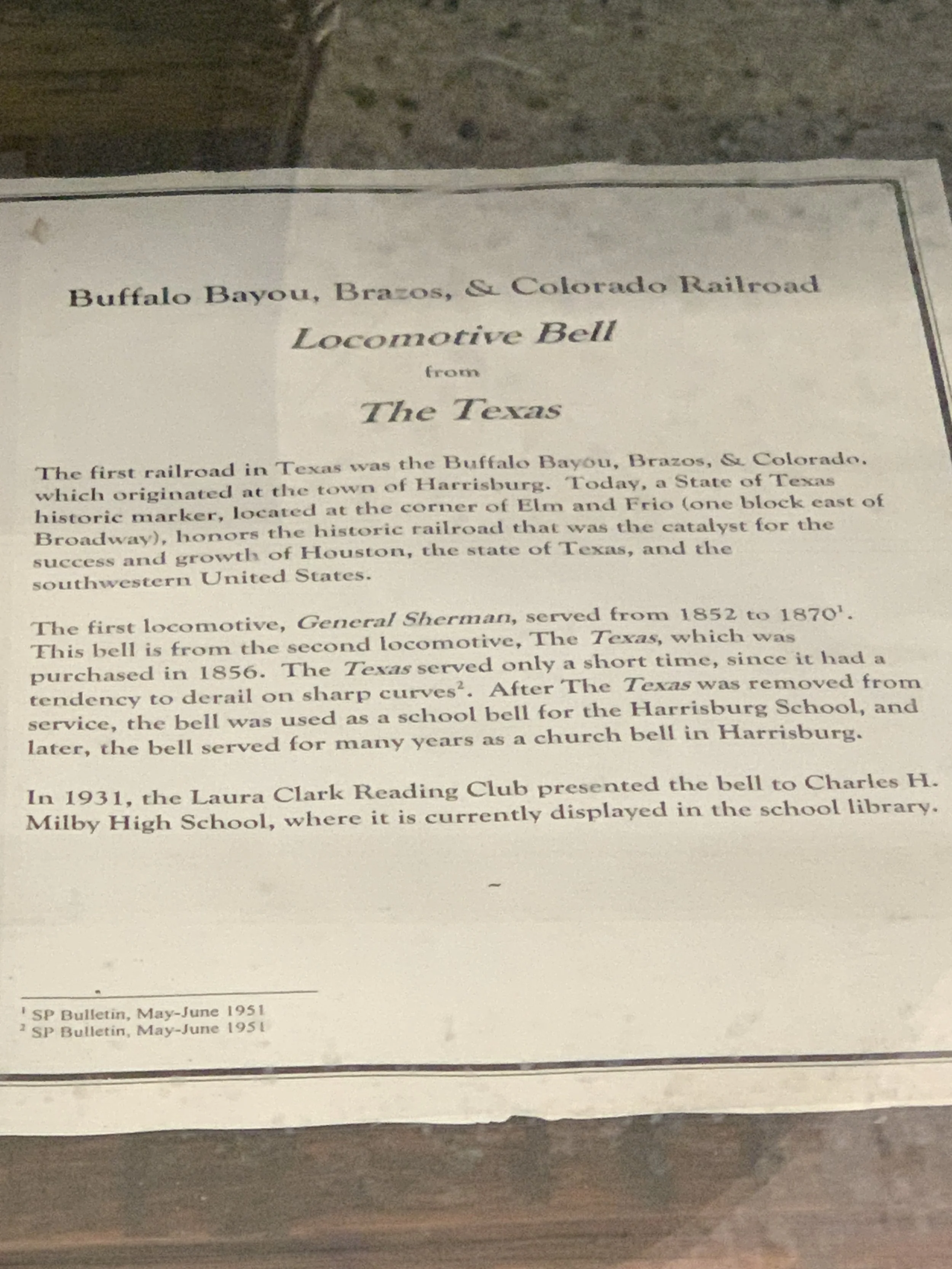
SP Bulltein, May-June 1951 Mibly HS.
Here is what is on the document says verbatim on the trains history and how it made it to the school; from SP Bulletin, May- June 1951
Buffalo Bayou, Brazos, & Colorado Railroad
Locomotive Bell
From
THE TEXAS
The first railroad in Texas was the Buffalo Bayou, Brazos, & Colorado, which originated at the town of Harrisburg. Today, a State of Texas historical marker, located at the corner of Elm and Frio ( one block east of Broadway, honors the historic railroad that was the catalyst for the success and growth of Houston, the state of Texas, and the southwestern United States.
The first locomotive, General Sherman, served from 1852 to 1807. This bell is from the second locomotive, The Texas, which was purchased in 1856. The Texas served only a short time, since it had a tendency to derail on sharp curves. After The Texas was removed from service, the bell was used as a school bell for the Harrisburg School, and later, the bell served for many years as a church bell in Harrisburg.
In 1931, the Laura Clark Reading Club presented the bell to the Charles H. Milby High School, where it is currently displayed in the school library.
So now we know the how and why this train bell is in the library of a local high school. How it was a bit of a journey for me to write this article and the wonder people who made this possible all along the way. Let this article be a case for going out into your own town, city and explore. You don’t have to go far to find out something interesting.
This article is dedicated to all of the students past and present at Milby High School.
